Showing posts with label Tourism. Show all posts

Friday, 13 July 2012

Lessons Learned While Traveling (Part I)


I’ve always wanted to travel full time. I imagined it would finally happen when I retired. I would live the transient life of adventure and see the world. It was all very romantic in my head.

I’m glad we’re traveling now, because if there’s one thing that the last five weeks have taught me, it’s that there’s a lot of things I won’t want to do when I’m 70. Namely, climbing steep hills and scrambling over wet rocks.

If I hadn’t experimented with traveling this summer, there’s a good chance I would’ve wasted a lot of time and energy stressing over the fact that I wasn’t on the road. I would’ve overlooked the good things about home in favor of dreaming about traveling. It’s the “grass is always greener” syndrome.

I still love to travel, but I feel I should be completely honest about the pros and cons of traveling. With that, here’s four things I learned this summer while dragging around a backpack, washing my sweat-soaked clothes in a sink, and occasionally saying nasty things to my adventure partner.

1. Visiting historic sites is overrated. 

The first thing anyone does when they visit a new place is map out all of the sites of importance and make it their mission to see them. This makes sense. Why go to Athens if you’re not going to see the Parthenon?

I’m not saying that you shouldn’t go and see the leaning tower of Pisa if your heart desires, but here’s the thing: if you find yourself feeling disappointed or underwhelmed, that’s ok. It’s not a sign that you’re not “getting it” or that you’re unable to recognize greatness; it’s that you’re trying to appreciate the past by visiting a place in the present.

The reason we want to visit these amazing places is because they have historical significance. It’s not so much about where it happened as what happened. For centuries, the Roman Forum was the heart of the city. Everything of importance happened at the Forum. You can walk in the footsteps of Cato the Elder, Julius Caesar, Marc Antony, and Marcus Tullius Cicero. That was the past. The footsteps surrounding you today are of less impressive men, and there's going to be lots of them.

Welcome!

If you’re visiting the Parthenon because you want to impress your friends with pictures on your Facebook wall, you’re going to be disappointed. You need to visit these places because they’re important to you, not because they’re important to someone else. If your heart’s not in it, you’ll be doubly pissed as you pour sweat and dodge aggressive salesmen trying to sell you overpriced stuff you don’t want.

Another reason you may find yourself wishing you’d saved your entrance fee for another round at the Irish pub is that we’ve been spoiled by technology. Thanks to the Internet, you’ve already seen every close up shot that any professional photographer could deliver. With a few simple clicks, you can see the individual brush strokes on the ceiling of the Sistine Chapel. You can take an HD virtual tour of some of the greatest monuments on Earth, and you’ll get to see more detail than you’ll ever see in person.

When you visit a monument in person, you’re going to be fighting through crowds of other tourists trying to get a picture that doesn’t have someone’s mullet in it. Additionally, most national treasures are roped off so that you can’t get anywhere near it, in the hopes that you won’t climb on it, write your name on it, or steal a part of it.

Take Stonehenge, for example. You can get an excellent view of Stonehenge from anywhere in the surrounding area. You can also pay £7.80/person (~$12/person) to visit Stonehenge. This visit gives you the chance to stand behind a rope and stare out into the distance at the circle, much like you can do in the parking lot for free. Your entrance fee also gets you an audio recording that explains how they still have no idea why/how it was built. Fascinating.

Some say it was aliens. Others disagree.

Museums are another place that can be a let down. As a nerd, I love a good museum, but I’m going to say the following in all honestly: once you’ve seen an exhibit’s worth of ancient Greek bowls, you really don’t have to see anymore of them. You can cross that one off your bucket list without feeling like an uncultured swine if you don’t want to see anymore.

After the first few hundred, you get the idea.


Everyone has their own personal list of must-see places. For me, it’s cathedrals and on a somewhat creepier note, grave sites. Yup, I like to visit the final resting places of historical figures. I have a weird obsession with pondering how a person can create a masterpiece, discover a scientific principle, or rise to greatness, and yet still end up in the same place that we all eventually find ourselves. It’s that whole “one life to live” concept personified.

I love cathedrals for a few reasons. They’re quiet, they’re usually the perfect mix of imposing yet beautiful, and the work that went into their construction is simply awe-inspiring. There’s nothing like standing in the echoing grandeur of a 12th-century building and marveling at how mere mortals were able to create such a massive, intricate structure without the aid of modern technology.

For me, nothing will be the same as visiting a grave or a cathedral in person. It’s up to you to define your own list, and that list might not include the Louvre or the Colosseum.  The important thing is that when you do visit your must-see places, you’ll know you’re visiting because they’re meaningful to you, and not just because they’re in a tourist guide.

To be continued…

Friday, 8 June 2012

When in Rome


As I sat down to write this post, I commented to my adventure partner that our apartment here in Rome reeks of eggplant and grease. We made parmesan-garlic battered eggplant for dinner and I had the fan turned on “high” so I couldn’t figure out why the scent was so strong. We just noticed that the fan above the stove vents into the room. So that was pretty pointless. I also remarked that it was weird that we didn’t set off the smoke alarm, but that’s because we don’t have one. I think I love Italy.

The best part about our apartment is the air conditioning (which was included free of charge!) We also have some more interesting amenities in the bathroom.

Me:     Ah, Christ. They have one of those things that freak me out.

K:        A bidet?

Me:     Yeah. I never know how to use these things.

K helpfully straddled the bidet while fully clothed and turned on the spigot.

K:       You just kind of do like this, you know, but with more splashing.

Like every American before me, I nodded and decided that I’m still not totally sold on the idea.


Still doesn't do it for me.

We spent a fair amount of time lazing about in our apartment. We didn’t eat out at a single restaurant while we were in Rome, preferring to save on expenses by shopping at the grocery store and making our own Italian dishes at home. We’re saving our culinary delights for Bologna, where we won’t have a kitchen and the restaurants are much cheaper.

The food we have made ourselves has been amazing! We’ve gone through a half a liter of olive oil, piles of fresh fruit and veggies, way too much Parmesan and balsamic vinegar, and a bit of fresh baked bread and basil-spinach pasta.

One pepper will get you through a few meals.

The only food we’ve had that wasn’t from the grocery store was the tiramisu gelato we had outside the Vatican. I imagine Jesus himself made it, as that’s the only way I can justify paying 8 euro for an ice cream cone.

The Vatican, like my gelato, was completely overrated. I’ve always wanted to visit the Sistine Chapel to gawk at Michelangelo’s work. I considered the Vatican to be the Catholic equivalent of a trip to Mecca. Like everything good in life, hoards of tourists have turned it into some kind of nightmare.

First of all, do not go to the Vatican at opening time. We wandered by the line at 9:00 am, and the crowds wrapped around two streets. I’ve never seen anything like it. Thousands of people baking in the Mediterranean sun, as aggressive salesmen tried to hawk their wares. When we returned at 11:30, there were maybe 50 people in front of us. Perfect.

These 50 people combined with the hundreds who were still in line to get into the Sistine Chapel. I should preface this by saying I hate crowds, mostly because there is a direct correlation between the number of people and the amount of stupid shit they think they can get away with. Anonymity changes people and all traces of human decency die in a crowd. Imagine an airport, and tell me I’m not wrong.

This is the only reason I can come up with for why people think it’s acceptable to toss their garbage on the floor of the Sistine Chapel, while pushing and shoving each other down the marble stairs and completely ignoring the clearly posted dress code. Jesus doesn’t want to see your sunburnt tits.

The other major downside to the Vatican (which really shouldn’t have surprised me) is that they charge for EVERYTHING. We decided to mail postcards to our moms from the Vatican post office so they could have a cool stamp (surprise, Moms!) They won’t let you borrow a pen; you have to buy one for 1.50 euro. I call bullshit, but that being said, I now own a Vatican pen. Sigh.

The other attractions we saw in Rome were totally worth it. I played the part of the wide-eyed, stunned tourist at the Colosseum.

It's just so cool!!

Don’t stand in line at the Colosseum itself. Wander up the road a bit further to the Roman Forum entrance where there’s no line, and buy your tickets there. The ticket to the Forum includes your entrance fee for everything else, and the exit dumps you directly in front of the Colosseum.

The Forum

The Colosseum, like every attraction in Europe, is surrounded by people trying to sell you things, but they weren’t as aggressive as I’m used to seeing and they were open to haggling. I bought two silk scarves to prevent further burning my pasty Euro-tanned skin.

My favorite place to visit was the Pantheon, and not just because it was free. It’s in remarkably good shape for being a few thousand years old, and the interior was gorgeous. Don’t forget to take a picture of Raphael’s tomb while you’re there, but avoid taking any pictures with the gladiators. They charge for that.

All in all, Rome was a great place to visit. The local wine is cheap, the produce is delicious, and the Italian (not Vatican) postal workers were friendly and helpful.

You can't turn around without seeing a cool sculpture.

The metro is easy to use, but not nearly as clean as Barcelona’s. I’m glad we opted for an apartment while we were here, as I desperately needed to do my laundry somewhere other than a hostel shower and having our own kitchenette was great, even if I am sitting in a haze of eggplant parmesan smoke.

Tuesday, 5 June 2012

Sagrada Familia


No trip to Barcelona would be complete without visiting Sagrada Familia, so that’s where we started. Sagrada Familia is a massive basilica designed by Antoni Gaudi. It’s been under construction since 1882 and won’t be completed for at least another decade. Their goal is to complete the entire thing in 2026, to celebrate the centennial of Gaudi’s death, but I think that’s a rather ambitious goal.


The construction is a private contract, and many things have contributed to the length of its construction. Funding will always be an issue for a building of this magnitude, but even more problematic was the Spanish Civil War. Plans and photographs were stolen, and sections of the church were destroyed. Luckily, construction continues, and the entrance fees to visit the church are contributed to the building fund. Even though it’s not complete, it was recently declared a UNESCO World Heritage site.

It’s a stunning building, inside and out. You could stare at it for days and never see all of the details. Each and every piece of the cathedral represents something, from the number of pillars to the style of the façades.

We arrived at the Passion Façade, which was K’s favorite portion of the exterior.  As expected, it depicts the Passion of Christ, but we would have missed half of the details if we hadn’t spent the extra 3 euro on the audio guide. For example, on one section of the wall is a series of numbers that is actually a puzzle. No matter how you add up the rows and columns of numbers, they always equal 33, or Jesus’s age when he died. All of the sculptures on this façade are sharply carved and free of ornamentation. The entire wall appears stark and skeletal, but it’s oddly attractive.


Inside, it’s a cascade of colors and columns. Gaudi’s love of nature can be seen in every detail, from the way the pillars resemble a forest to the spiral shell staircase that seemingly reaches towards the heavens.

The columns are meant to look like a forest.

I’ve visited more cathedrals than I can count, in several countries, and nothing prepared me for the beauty of this interior. I can’t put into words how gorgeous this structure is, and pictures just can’t do it justice.

Light from the stained glass reflecting off the pipe organ.

Catholic or not, this basilica will leave you speechless for a moment. You can view the official image gallery of the building here.

We exited through the Glory Façade, which will eventually be the main entrance to the church. On the massive door, you can read “Our Daily Bread” in 50 different languages.

We wrapped around to the Nativity Façade, which is the busiest looking section of the church. It is literally covered with sculptures and decorations, which is meant to be a contrast to the Passion Façade. Everywhere you look you see trees, animals, and scenes of Jesus’s birth and childhood. Above all of this stands a sculpture of the Tree of Life, with doves nesting in the branches.

We spent almost 3 hours at Sagrada Familia, and I can’t wait to return. I would love to see the finished product, so I guess we’ll be returning to Barcelona in 15 years or so.

Saturday, 21 April 2012

Beaches, Buses, and Bars


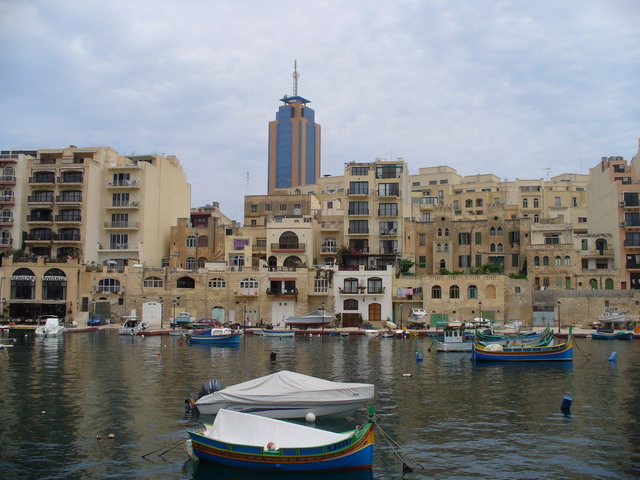
We spent the first few days in St. Julians, which is known for its lively nightlife. Bars stay open until 4:00 or 5:00 in the morning if you can stay awake that long, which is quite popular with the younger crowd.


St. Julians

After a day of wandering St. Julians and Sliema, we decided to escape the city via a sightseeing bus. If you choose to ride on the top, pay attention or you might catch a palm tree with your face. Slightly embarrassing at the time, but it provided plenty of amusement for the other riders.

The first place we stopped at was Marsaxlokk, a fishing village on the south side of Malta. The highlight of this harbour town is the brightly painted fishing boats, called luzzus. Most have a pair of eyes painted on the front to protect against evil, which probably saves them having to purchase insurance. Not surprisingly, Marsaxlokk is known for its seafood restaurants lining the harbour area. There’s also a decent souvenir market, but the tapestries we found here were three times more expensive than in other villages.


Luzzus in Marsaxlokk

Next up, we stopped at the Blue Grotto, which is a stunning section of the southern coast, popular with divers. This is a rocky section of coastline, with several caves and sparkling water in various shades of blue. It’s the perfect photo opportunity, with plenty of restaurants offering balconies and great views.

Along with our bus tour, we received a complimentary harbour cruise around Sliema’s Marsamxetto Harbour and Valletta’s Grand Harbour with Latini Cruises. The cruise took around an hour and a half, and would have been a very pleasant trip had it not been windy and raining. Freezing my ass off while wearing a plastic poncho is not my idea of fun, but the crew did their best to make the trip enjoyable, passing out blankets and making as much space behind the glass as possible. I would love to try it again on a sunnier day.


Grand Harbour, Valletta

After a few days, we moved up the coast to the much more laid-back town of Mellieha. The nightlife is quiet, intimate, and perfect for me: small pubs and bars with a mellow atmosphere. Mellieha has a nice stretch of sandy beach with sun loungers and umbrellas for rent, which made for a very relaxing afternoon.


Mellieha

For variety, we caught the bus from Mellieha to Cirkewwa, and hopped on the ferry to the northern island of Gozo.  The ferry takes about 30 minutes and lands at Mgarr. After running the gauntlet of overeager, pushy tour operators, we caught a bus to the town of Xaghra, on northern side of the island. We rambled over to Calypso’s Cave (from Homer’s Odyssey) and hiked down the hill to Ramla Beach. Ramla is covered with red sand, and was a great place to soak up some sun. There’s three beach front restaurants, offering typical snacks, pizza, and drinks.

I thought six days would be plenty of time to see all Malta had to offer, but I was wrong. I could’ve easily spent another week and not seen everything on my list. We had booked a cruise around Comino and the Blue Lagoon, which was canceled due to wind, and I also wanted to visit some of the wineries and see the glass blowers. We didn’t get a chance to see any of the ruins, and only briefly visited one church in Mellieha. I’m counting all of this as an excuse to visit again!
Follow Me on Twitter