Showing posts with label friendship. Show all posts

Tuesday, 14 August 2012

Eight Days at Veggie Camp


I recently attended a meditation instructor course at a residential retreat. I showed up fully prepared for 14 hour days of intense personal development (or so I thought).  Instead, I quickly discovered how far out of my element I really was, and learned that it’s necessary to step out of my comfort zone if I want to experience positive change.

When I arrived, the retreat brochure assured me that I was in hippie heaven. I heard phrases like “peace and harmony,” “expanding awareness,” and “awakening the inner self” everywhere I turned. I was excited to see plenty of dreadlocks and tie-dyed ponchos, and felt instantly cooler by association.

I became slightly wary when I noticed an outhouse labeled “compost loo.” I began forming a mental list of dings against my certified hippie card:

1. Any place that composts their own shit is a step too far for me.

Little did I know, this would be the start of many new realizations.

The effects of the vegetarian diet showed me the second reason I can’t be a fully-fledged hippie: After a childhood full of Little Debbie cakes and Hamburger Helper, my body is ill-prepared to handle “all-natural.”

By Day 3, I was overcome by muscle cramps, an angry tummy, and a very unpredictable mood. I felt like I was dying, but death just wouldn’t come. I called my adventure partner and told him to pick me up. He declined the opportunity to drive another 7 hours to rescue me. When I called on Day 4 he agreed, but we would’ve been unprepared for the movers to pack up our house the following day. I was stuck.

Our instructor (who was amazing) assured us that any negative emotions or physical symptoms we might be experiencing were the result of our bodies resisting change. Change is new, and new is scary. He also helpfully added that it could be due to the detox process of adjusting to a healthy diet. I immediately understood what I had to do if I was going to survive this week: It was time to retox.

One trip to Tesco for vodka, a Cajun chicken wrap, and some peperami sticks later, I was back in business! For the record, I didn’t just spell “pepperoni” incorrectly. Peperami is a British snack stick that’s like pepperoni but with less meat and more ‘rami. It’s the third cousin of the Slim Jim. If you’re going to retox, you can’t go wrong with fake meat sticks and vodka.

It tastes about as good as you would expect.

Fully loaded with preservatives, liquor, and an ungodly amount of sodium, I attacked the week with new enthusiasm. My trip to Tesco wouldn’t have been possible without the assistance of two wonderful women, which brings me to my next realization of the week:

3. You can survive anything if you have good friends.

I met some of the most interesting, warm, and welcoming people I’ve ever had the pleasure of knowing that week. They in turn introduced me to some of the strangest things I’ve ever heard of. Words like “chakra” and “aura” were thrown about with reckless abandon, and it seemed everyone had a more exciting past life than I did.

As a solid skeptic with an affinity for the scientific method, I found that I had nothing to add to conversations about souls, spiritual essences, or energy fields. I decided to suspend all judgments, and luckily for me, my fellow companions accepted me as I was.

At one point, one of the coolest chicks I met told me about bioenergy feedback sessions. The part of her explanation that stuck with me involved the removal of negative entities. As a former devout Catholic, the first thing that came to mind was exorcisms.

Sleep well!

Later that night as I slept in a 19th century stable block, I had a nightmare involving her pulling a demon out of my friend Magic Muskrat’s chest. The demon flew across the room and brushed against my leg, causing me to feel a cold chill. I awoke in a panic and realized that my leg was freezing in real life. I flipped out. Then I realized that I had my window open, it was a breezy 50 degrees Fahrenheit in my room, and my leg wasn’t under the duvet. In short, I’m an idiot.

In order to sleep the following night, I watched a live session. At no point did any demons appear, and I slept like a baby.

The rest of the week flew by, and my introverted self couldn’t help but be dragged into the enthusiasm of the group. I experienced every emotion under the sun. I laughed until I couldn’t stand and sobbed my eyes out on a new friend’s shoulder. I learned to trust people and not be so guarded. After two straight years of wanting to get the hell out of England, I finally had a reason to miss it.

I still have more requirements to complete before I become a fully certified meditation instructor, and I may not be as much of a hippie as I thought I was, but I can say with full conviction that my week at veggie camp has changed me for the better. So thank you, from the bottom of heart, to all of the wonderful people I met at this course. I’m blessed to have met each one of you.

Tuesday, 19 June 2012

The Best Thing Since Sliced Bread


No one in Croatia says “the best thing since sliced bread.” This is because they don’t have sliced bread. K says that we could make a fortune by bringing over sliced bread, fitted sheets, brooms, and peanut butter.

Tell me a swiffer wouldn't blow their minds.

It’s not that we’re bashing on Croatia, because we love this place. However, if there’s one thing traveling will do, it’s remind you of everything you miss from home.

I should start by saying that I’m suffering from some overwhelming homesickness at the moment, as I missed an important family event last weekend. Additionally, I’m taking an upcoming trip to my adventure partner’s home of origin, and the excitement of seeing our friends and family is about to kill me.

I feel incredibly blessed to have the opportunity to travel and see the world through the lens of other cultures. There’s nothing quite as cool as experiencing the way another country navigates through life.  I can also appreciate the things that other countries have embraced that I wish America had (roundabouts, open air markets, and free healthcare, anyone?) However, that doesn’t mean I’ve forgotten all of things that make my home special.

With that in mind, I dedicate this post to things that I miss about America.

1. Convenience. This doesn’t just mean the convenience of being able to buy ammo, a pregnancy test, bacon, and a lawn mower at two in the morning. Convenience is an all-encompassing phenomenon in the states. I can get anything I need, at any time, and I can probably get it from a drive-thru.

The biggest convenience I miss at this point is a washer and dryer. A full-size washer and dryer, not that 2-gallon combination piece of shit that Europe has embraced. I don’t want to say that I’m tired of washing my clothes in a mop bucket and stringing them around the room, but there’s probably more artistic ways to decorate a kitchen.

2. Grocery stores. Yes, every country has grocery stores, but not in the way that we know and love. This goes along with my comments on convenience. Grocery stores are not open at a time that would be conducive to anyone with a job. Even the ones that boast “24 hours” are only open from 10 a.m. to 4 p.m. on Sundays. This means that everyone is trying to cram into the dairy aisle on Saturdays, and no one is enjoying themselves. Tesco is the most hostile place I’ve ever been.

Additionally, each country organizes their store in a different way, and it never makes sense. For example, you would think that cinnamon sticks would be in the aisle with the rest of the spices, right? No. Cinnamon sticks are located next to the flour, which is near the bakery, which is on the other side of the store.

Eggs should be in the refrigerated section next to the milk and butter, but instead you’ll find them on the shelf next to the canned hot dogs, because why the hell not? As an aside, canned hot dogs are surprisingly delicious. Desperation is an ugly animal.

3. Street signs. The first step to getting where you need to go is knowing where you are right now. I’m not even trying to be cute and metaphorical there; I seriously have no idea where the hell I am most of the time. You know those green signs with clearly printed white letters that tell you what street you’re on? Yeah, no one else does that.

Roads that are wide enough to accommodate two cars simultaneously are also a bit of an oddity. It’s much easier to build one lane, label it as 60 mph, and then put up a warning sign. Problem solved!

I could probably create an entirely separate blog about roads and all things automotive related, so I’ll limit this rant to one more thing: grid patterned streets. Miss your turn? That’s cool! Take the next one.

I understand that most of the roads in England are older than my country, so it makes sense that they would follow whatever plan was laid out centuries ago. However, they continue their eclectic patterns of squiggles and loops in their new developments, presumably so that it will blend with the rest of the area.

4. Familiar foods. I can’t belittle the culinary delights of the places I’ve visited. Every country has its own amazing dishes, from sushi in Japan to fresh feta in Greece. I love food, LOVE it, and the variety of flavors has been one of the most rewarding things about living and traveling abroad.

I wouldn’t trade the delicious food experiences I’ve had for anything, but everyone has their favorite foods from home. I make a list of specific things I have to eat each time I visit the states, and none of them could be considered culinary masterpieces. Red Lobster cheesy biscuits, Dairy Queen’s chicken strip basket (God help you if doesn’t have the country gravy), eggs benedict, and that bowl thing from KFC that has their entire menu swimming in mashed potatoes. Don’t act like you don’t know which one I’m talking about! None of these things could hold a candle to the homemade ricotta and balsamic vinegar I had in Italy, but I still miss them!

I miss them because they taste like home. They taste like happy memories at familiar places, and no amount of moussaka in Crete can make up for that (although God knows I’ve tried!) Which brings me to the most important thing I miss about home…

5. Friends and family (and friends that ARE family).
It doesn’t matter how many wonderful people I meet on my travels, no one will compare to my friends and family back home. Yes, you make look around at your family and think they’re all bat shit crazy (because they probably are) but they made you who you are today. They’re irreplaceable.

One of the driving forces behind a love of travel is the fact that you can be anyone you want during your trip. No one knows who you are. They don’t know your history or the fact that you still sucked your thumb all the way through kindergarten and are hopelessly uncoordinated. For all they know, you’re whoever (and whatever) you say you are.

At home, there are people who watched you puke all over your desk in Mr. B’s freshman science class, and they love you just the same. As cool as it is to be whoever you want to be for a week, there’s nothing quite the same as knowing that there’s people out there who love you unconditionally. No matter how much I see and how far I travel, these are the people that make me want to come home.

But I seriously need a washer and dryer.

Thursday, 3 May 2012

Alone with our Technology: Part Three


In the first two posts, I covered why time away from technology is important for our growth as individuals. We need that quiet space to sit and think, to understand that being alone isn’t something to fear, and that we don’t have to be “on” all the time. The call of technology is loud; we’ve become accustomed to on-demand entertainment and we worry about missing out if we log off. One of the scariest things about logging off is that we may discover that without the constant stream of someone else’s updates, we’re bored. Yes, there is a very good chance that you might find out that you, the master of witty status updates, are boring.

By C-SPAN (WP:CSPAN) [CC-BY-SA-2.0 (http://creativecommons.org/licenses/by-sa/2.0)], via Wikimedia Commons
Is this more exciting than being alone with your thoughts?


This is the risk we take when we log off. However, as with any risk, there’s an equally good chance that the experience could surprise us in a good way. After a period of separation, we may find that we value the presence of others more than before, but we’ll never know if we don’t take that first, scary step. In the words of Deresiewicz, “The more we keep aloneness at bay, the less are we able to deal with it and the more terrifying it gets.”

Rediscovering solitude requires us to first acknowledge the role that social networking plays in our lives. Disalvo explains in Scientific American, “As social networks proliferate, they are changing the way people think about the Internet, from a tool used in solitary anonymity to a medium that touches on questions about human nature and identity: who we are, how we feel about ourselves, and how we act toward one another.”  If we learn to enjoy life without constant connectivity, we can learn to use technology as a tool instead of a crutch. Instead of using the Internet to IM our friends, we could invite them to meet us in person.

Courtesy of Rodrigo Suarez on Flickr, http://www.flickr.com/photos/ervega/2730585942/
Communicating offline.


Another option is to use the Internet as a way to get out and meet new people. Try using MeetUp.com or googling local groups that share your interests: book clubs, amateur theater groups, or intramural sports. Even if we can’t meet face-to-face, we can video chat with our friends and family to help reestablish those nonverbal cues.

We can once again find the balance between intimacy and isolation, logged in and unplugged. We can appreciate quality friendships over a quantity of acquaintances, and we can use social networking to our advantage. You may have 600 “friends” but Dunbar’s number proposes that we can cognitively maintain a maximum of 150 actual relationships. At 150, we have time to properly nourish these relationships, as well as focus on our own individual growth. Consider the problems associated with maintaining several hundred friendships:

1. The people who don’t matter distract you from the ones who do.

Let’s be honest. As useful as social networking can be, it’s also a massive time suck and the perfect procrastination tool. I would love to finish that paper, but I have to comment on my colleague’s vacation photos or she’ll think I don’t care. Typically this analogy applies to your work, but it can also be used on your real relationships. It’s easy to become distracted by everyone’s random links and statuses, and miss out on the information from people who really matter. More than once I’ve been distracted by photo albums and links to articles and then completely forgotten to send that email I promised to a family member. We need to know how many relationships we can honestly maintain at one time, and then give our full attention to the ones that matter.

2. The intimate details of strangers cheapen your real friendships.

I’m sure you have a few people in your friends’ list who are casual acquaintances at best. Maybe you met them once at a party, or you worked together for a few weeks. At any rate, these are not the kind of people you hang out with on a regular basis, but I bet you know a lot about them. Without even being nosey, you are inundated by pictures of their children, updates about their daily personal struggles, and information about the issues that matter to them. In effect, you know the quirks, features, and virtues that make them a unique individual. These details used to be reserved for close friends, shared over dinner after years of knowing one another. If you know everything about everyone, what makes those intimate details special?


3. Dragging your past into your present can sour your memories.

There’s probably a few other friends in your list that at one time, you knew very well. Someone from high school or college will normally work for this example. You had so much in common and were great friends. You vacationed together, drank together, and genuinely enjoyed each other’s company. Note the use of past tense...

Normal life events would’ve taken you on your separate paths, and you would’ve looked back on your years together with a smile. Thanks to social networking, you are still in contact with them and to be perfectly honest, they annoy the shit out of you. You’ve both grown in different directions and hold opposing world views. Sometimes you wonder why you ever liked this person in the first place. If your past had stayed in the past, your memories of this person would still be good ones.

Think of it like a bouquet of flowers. Yes, they were beautiful and were a wonderful addition to your life, but now the dead leaves are making a mess on your counter and it’s time to let them go.

4. Your friends hate your other friends.

Social networking has this amazing way of bringing together your past and present and then letting them engage each other for all to see. I’ve seen far too many status updates turn into a slew of insults from people who have never met and have nothing in common but you. Lists and filters are helpful, but it was much easier to compartmentalize our various social groups before we had an online presence. If nothing else, at least our grandma didn’t have the option of reading a hate-filled comment stream.

Social networking is here to stay, and can offer us some amazing benefits. On the flip side, it can also cause us more than a few headaches. As with all things, it’s a matter of finding the balance. From time to time, it’s ok to unplug and simply be alone with our thoughts. To put the world on pause, and rest without computers or smart phones. Consider it a vacation from the network.  You could even try it out while on vacation.

By Infrogmation of New Orleans (Photo by Infrogmation (talk) of New Orleans) [GFDL (http://www.gnu.org/copyleft/fdl.html) or CC-BY-3.0 (http://creativecommons.org/licenses/by/3.0)], via Wikimedia Commons
A cell phone free zone.


In part one, I mentioned that Montaigne called this space our “backshop, wholly our own and entirely free.” It’s a space where you can do whatever you want, be whoever you are, and not have to answer to anyone. Being alone and away from the network doesn’t have to be something we stress about. It’s a break from the world. Enjoy it!

Deresiewicz, William. “The End of Solitude.” Chronicle of Higher Education 55.21 (2009): B6-B9. Web.

Disalvo, David. “Are Social Networks Messing with Your Head?” Scientific American Mind 20.7 (2010): 48-55. Web.

Montaigne, Michel de. The Complete Essays of Montaigne. Trans. Charles Cotton. 1877. Web.

Tuesday, 1 May 2012

Alone with our Technology: Part One


One of my passions is investigating the role of social networking in our personal lives. As I have a blog and spend most of the day online, I can appreciate the way the Internet allows me to connect with a wider audience, in a way that no previous piece of technology has been able to accomplish. With the prevalence of smartphones and tablet PC’s, we literally hold in our hands the ability to reach out anywhere, anytime. Although I love this ability, I find myself wondering if continual connectivity is too good to be true. My fear for the technology generation is that by allowing ourselves to be perpetually "plugged in" we’re giving up an essential piece of our humanity: our ability to be alone.

I want to share my thoughts on the balance between technology and solitude to you in a series of posts. The irony of using a blog to explain why it’s important to unplug and be by ourselves for awhile isn’t lost on me. If you prefer video to reading, I’m including a link to Sherry Turkle’s TED talk at the end of this post. Turkle, a Professor of the Social Studies of Science and Technology at MIT, recently wrote the book Alone Together. It’s a fantastic read and I can’t recommend it enough.

Additionally, I would like to point out that although I typically use Facebook as an example, I’m referring to all social media sites. Facebook just happens to be the most popular, and I’m generalizing for the sake of brevity. Relax, Twitter fans. I respect all 140 characters of your opinion.

So why do I advocate solitude? Many confuse this word with loneliness and imagine eccentrics in caves or the weird kid sitting alone in the cafeteria. According to a 1993 Washington Post article, we fear solitude when we "unfairly equate 'alone' with 'lonely.' And a whole host of other unhappy words, like friendless, unlikable, unlovable, unloved." Solitude is, quite simply, the state of being alone, without any of the negative or positive emotions we may attach to the word.

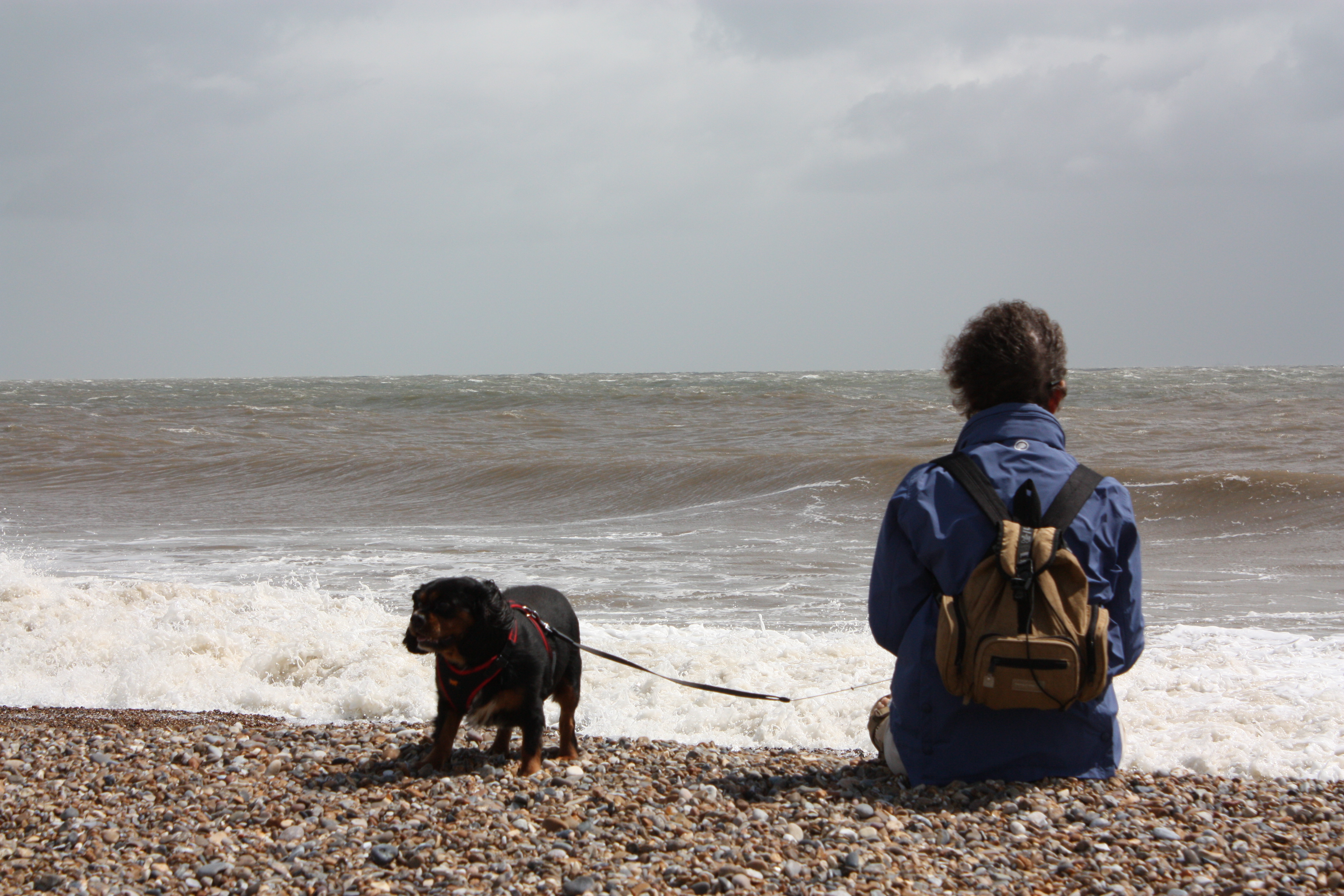
The dog won't care if you're alone with your thoughts.

When we view solitude as something more emotionally charged than this, we naturally want to avoid it. Thanks to technology, we have an easy way to this. William Deresiewicz, a former English professor at Yale, noticed a trend amongst his students. More and more of them were mentioning that they didn’t enjoy being alone, even when they were studying. He has since written about the way technology allows us to be physically separated, without ever being alone. He fears that in losing our solitude, we have also lost "the propensity for introspection, that examination of the self that the Puritans, and the Romantics, and the modernists (and Socrates, for that matter) placed at the center of spiritual life."

Regardless of how you define "spiritual life," solitude has always been necessary place to explore your own thoughts and feelings. After all, if you don’t understand you own mind, how can you understand the workings of someone else’s? Alone, we take the time to nurture our minds and ourselves; we take the time to explore hobbies and read books. The poet Francis Petrarch wrote: "Isolation without literature is exile, prison, and torture; supply literature, and it becomes your country, freedom, and delight." He had good reason to be biased, but he’s not wrong.

Michel de Montaigne wrote an entire essay about his love of solitude arguing, "We have lived enough for others; let us at least live out the small remnant of life for ourselves." Deresiewicz’s university students found solitude to be uncomfortable, whereas Montaigne felt that “the greatest thing in the world is for a man to know that he is his own.” Through his work, he taught others how to separate themselves from the masses and learn to trust in their own company. Online, we leave behind his “backshop, wholly our own and entirely free” in order to lose ourselves in the quiet glow of our computer screens.

Facebook, the most popular social networking site worldwide, warmly asks it users, “What’s on your mind?” In the book I mentioned earlier, Turkle points out that “Every day each of us is bombarded by people’s random thoughts. We start to see such effusions as natural.” Does the world really need to know what’s on our mind at any given moment? And why do we feel the need to check in several times each day to read the ramblings of someone else’s life?

We have developed a fear of missing out. If something happens and we don’t read about it in a status update, we fear that we’ll be left out of the gossip. We want to feel as though we’re a part of the group. We need to know that we matter. Similarly, we need to demonstrate to the rest of the world that we’re doing something with our time. We’re exciting, interesting people dammit!

Deresiewicz wrote, “This is what the contemporary self wants. It wants to be recognized, wants to be connected: It wants to be visible.” In this desperate drive to reach out, connect, and share, we’ve become even lonelier than before. We’ve increased the quantity of connections, but we’ve lost the quality. We’re losing a bidding war to be heard as we broadcast the mundane details of our lives. I can almost hear John C. Reilly singing “Mister Cellophane”:

Everyone gets noticed, now and then,
Unless, of course, that personage should be
Invisible, inconsequential me!

No matter how boring the update, we want to connect! Human beings are social animals, and the Internet can be great for reaching out to faraway friends and family. However, the quality of communication we have is greatly enhanced by our perception of their expressions. Robert Putnam expressed this concern in his best-selling book, Bowling Alone. “Computer-mediated communication, now and for the foreseeable future, masks the enormous amount of nonverbal communication that takes place during even the most casual face-to-face encounter.”

An email (even with emoticons, all caps, and excessive punctuation) can’t convey the same amount of information as a face-to-face encounter. We miss the nonverbal cues when we scroll through our Twitter feeds or respond via text. In a live conversation, we don’t have the option of pausing for two minutes and rewording our response. We can tell when our friend’s eyes light up at our news or look away with disappointment. In short, we’re more “real” when we don’t have the option of polishing our response.

The other aspect of quality we’re missing is the ability to know if we have our friend’s full attention. When we’re IM’ing or even talking on the phone, we have no way of knowing if our friend is fully focused on our story, or if they’re also maintaining four other conversations. Does that “Mm-hmm” mean they’re nodding in agreement, or passively acknowledging us while scrolling through their inbox? Turkle pointed out, “We enjoy continual connection but rarely have each other’s full attention.” We don’t feel completely alone, but we don’t feel completely connected either. As social networking grows and increasingly becomes the preferred way to connect, author David Disalvo worries that it “will supplant the richness of real-world relationships with an endless stream of trivial interactions.”

Convenient, but not ideal.

It’s so easy to pull away from others and drift towards the safer world of online communication. Rejection online isn’t the same as having to face the awkwardness of rejection in real life. The world of the Internet is faster, more animated, and involves less of an emotional investment. It’s the fast food of social interaction; who wouldn’t see the appeal?

Take a Facebook friendship, for example. We can interact with snippets of their personality, respond to the comments we find favorable, and ignore or even filter out the aspects that we don’t like. We never have to deal with a whole person, for better or for worse. We can choose which side of their personality to engage. It’s a way for us to be in a “relationship” but protect ourselves at the same time. However, when we only focus on the parts of a person that we agree with, we lose out on the richness of true human relationships. Instead, we fade in and out of our digital worlds without ever experiencing the full weight of friendship and interaction. It’s not hard to see how this superficial communication would leave us feeling lonely, even when we’re not alone.

Brown, Joe. “Me, Myself and I.” Washington Post 15 Oct 1993, Final: N7. Digital.

Deresiewicz, William. “The End of Solitude.” Chronicle of Higher Education 55.21 (2009): B6-B9. Web.

Disalvo, David. “Are Social Networks Messing with Your Head?” Scientific American Mind 20.7 (2010): 48-55. Web.

Montaigne, Michel de. The Complete Essays of Montaigne. Trans. Charles Cotton. 1877. Web.

Petrarch, Francis. The Life of Solitude. Trans. Jacob Zeitlin. Urbana, IL: University of Illinois Press, 1924. Print.

Putnam, Robert. Bowling Alone: The Collapse and Revival of American Community. New York, NY: Simon & Schuster Paperbacks, 2000. Print.

Turkle, Sherry. Alone Together: Why We Expect More from Technology and Less from Each Other. New York, NY: Basic Books, 2010. Digital.

Follow Me on Twitter